


Overview
Open-Source Billing Infrastructure You Own and Control
Kill Bill is an open-source subscription billing and payments platform, released under the Apache 2.0 license and in production since 2010. You deploy it in your own infrastructure, customize it, and extend it with plugins, without asking permission or paying royalties.
SaaS billing vendors lock you in with per-transaction fees that grow as you scale. Kill Bill has none.
Last updated: October 2026
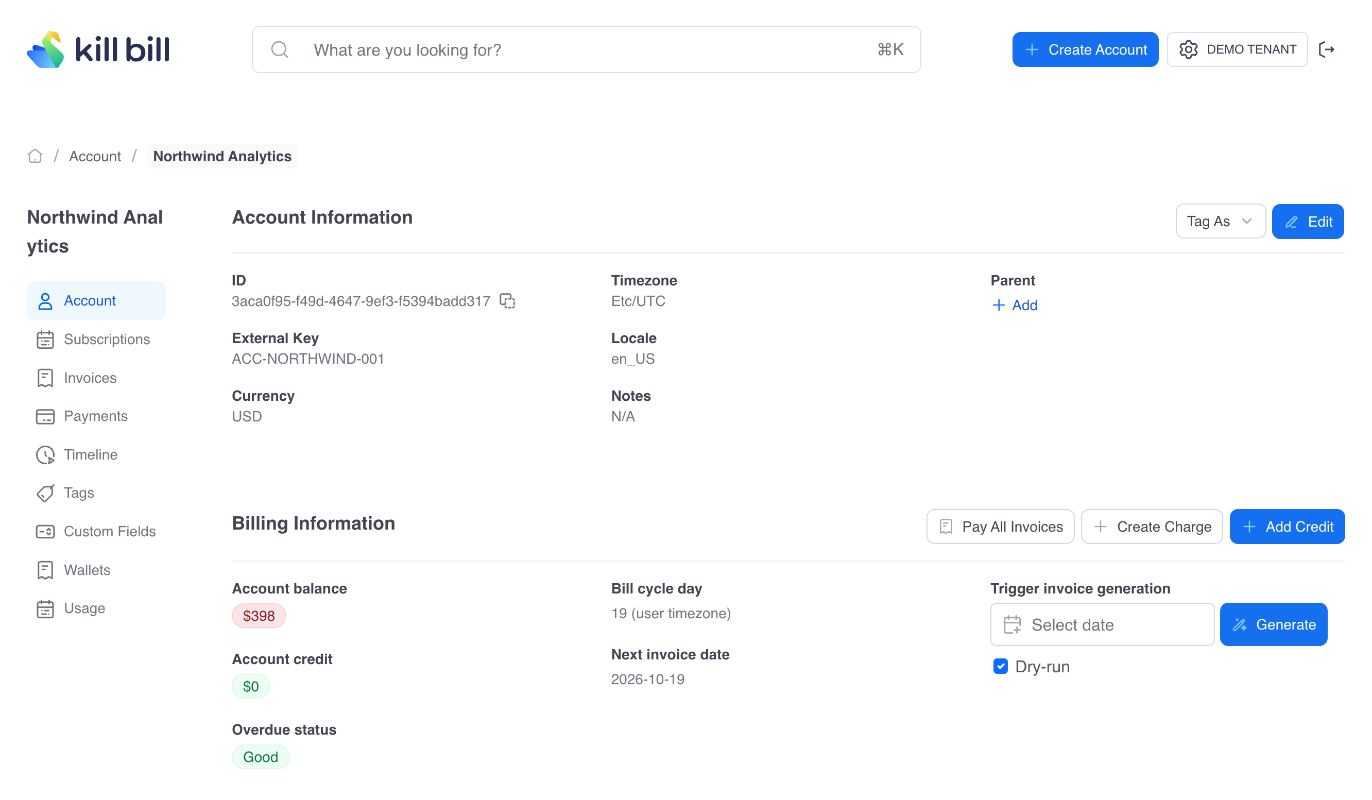
Kaui, the admin UI that ships with Kill Bill. Demo data.

In production since 2010Open source, Apache 2.0

Your infrastructureYour database, your data

No per-transaction feesFree to use and modify

PluginsPayment gateways, tax engines, your own logic
At a Glance
Kill Bill at a Glance
- What it is
- Open-source platform for subscriptions, usage billing, invoicing and payments
- License
- Apache 2.0, free to use and modify
- Source code
- github.com/killbill/killbill
- In production since
- 2010
- Written in
 Java
Java- Deployment
- Self-hosted, on premises or in your cloud.
 Docker images
 AWS images
 - Databases
 MySQL
MySQL MariaDB
 PostgreSQL
- Interfaces
- REST API and Kaui, the admin UI
- Payments
- Plugins for



 and others
 - Tax
- Plugins for


 Kintsugi
 - Help
- Community mailing list and documentation. No SLA on the open-source project
- Enterprise offer
 Aviatebuilt on Kill Bill by the same team

Accept every major payment method
Visa
Mastercard
Amex
PayPal
ACH
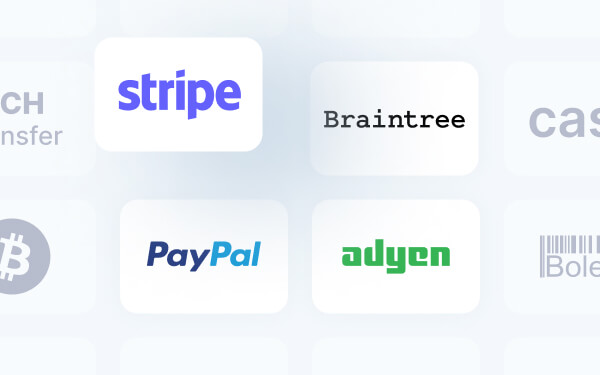
Integrate with any payment gateway worldwide
Adyen
Braintree
Stripe
PayPal
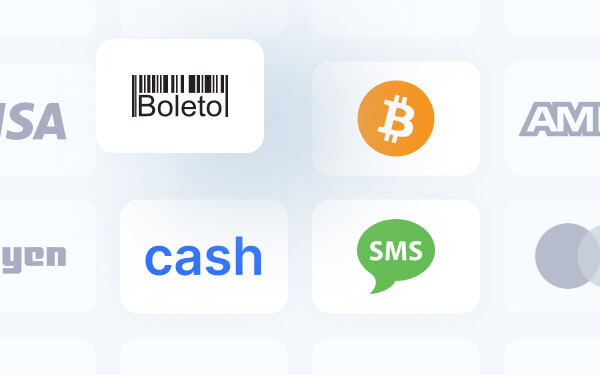
Support alternative payments and digital currencies
Cash
SMS
Bitcoin
Boleto
Through plugins. The catalog supports any currency, including crypto-currencies.
How Kill Bill Works
Kill Bill has three parts.

Your dedicated billing engine
Kill Bill powers your back-end, processing customer activities through API calls triggered by your website actions (e.g., purchasing a year's subscription).
You create and implement the API calls that connect with the Kill Bill platform.

Persistent data you control
The database manages all the states associated with the subscriptions, invoices, payments, and so forth.

A back-office dashboard for your team
Kaui is an online user interface that lets your back-office people (for example, Finance or Support) interact with Kill Bill.
Kaui makes it possible for your employees to manage tasks like issuing refunds and adjusting invoices.
Open Source and Enterprise
Kill Bill and Aviate
Kill Bill is the open-source core. Aviate is the enterprise offer built on Kill Bill by the team that maintains the project.
Open source
Free under the Apache 2.0 license
- Subscriptions, usage billing, invoicing and payments
- REST API and the Kaui admin UI
- Payment and tax plugins
- Runs in your infrastructure, with your database
- Community support, no SLA
Aviate
Enterprise
Built on Kill Bill by the same team
- Control Plane: one web console for one or more deployments
- Enterprise modules: metering, wallet and credits, coupons, tax
- Level 3 support from the engineers who build the platform
Proven at Scale
In production since 2010
Kill Bill runs in highly regulated environments, including PCI-compliant payment processing and Fortune 500 deployments with complex multi-tenant billing. Deployments on the platform have invoiced billions of dollars since 2010.
Built for Complex Billing
Our sweet spot: companies with complex billing that want to scale billing infrastructure without scaling vendor bills.
Compliance-Ready Architecture
Kill Bill provides the technical controls enterprises use to meet SOC 2 and PCI DSS requirements: role-based access, audit logs, and gateway tokens instead of card numbers. Proven across years of enterprise deployments.
Multi-Tenant at Scale
White-label billing for platforms managing thousands of tenants across B2B, B2C, and B2B2C models.
Implementation
Deploy and manage in your own infrastructure
Or as a software appliance in the cloud

Run billing and payments out of the box
Kill Bill includes the features a business needs to run subscription billing and payment processes. Many organizations run Kill Bill as their billing system, with payment processing included.

Build custom logic on top
The real power of Kill Bill lies in building your own business logic on top of it to create a customized billing and payments solution. You can write plugins to modify Kill Bill’s behavior or integrate with third-party vendors.

Use open-source plugins or create your own
Kill Bill already has many open-source plugins. You can use them as examples for creating your own or modify them for your own use. For example:
Fraud detection solutions
Tax provider solutions
Credit card account updaters
Who It Is For
Who should use Kill Bill?
Kill Bill fits teams that want to own their billing system and extend it with code.

Online businesses
Any business that bills customers or accepts payments online can use Kill Bill as its billing system.

Teams that need full customization
You’re frustrated with the lack of customization available from the more popular SaaS billing-payment providers.

Startups
You’re a startup with a tight budget.
Kill Bill is right for your business if...
Your business requires integration with lesser-known payment gateway providers, such as those used internationally.
Your business needs to use a different fraud detection provider (or account updater or tax provider) than the one used by your payment gateway.
You need to run custom, decision-making code (examples: change amounts dynamically, abort payments with a rules engine due to fraud detection, modify invoices on-the-fly, customer payment retry logic).
You need real-time access to your organization’s data to build analytical and financial reports.
You need to integrate with your own internal applications (examples: for tax rates or tight integration with your catalog system).
You guessed it…
If you agree to any of these statements, check out Kill Bill’s open-source billing and payments platform features (not to mention Kaui). You can also read over some typical and not-so-typical Kill Bill use cases.
Security & Compliance
Enterprise-grade security, by design
Kill Bill is built for organizations that take data sovereignty and regulatory compliance seriously. Self-host in your own infrastructure with full source code transparency.
Self-Hosted Infrastructure
Your billing data never leaves your infrastructure. Deploy on-premises or in your own cloud with complete data sovereignty and network isolation.
Open-Source Auditability
Full source code inspection, with no black boxes. Your security team can audit every line of the billing engine before deployment.
PCI-Ready Architecture
Kill Bill stores the token your payment gateway returns, not the card number. With role-based access and a full audit trail, it gives you the building blocks for PCI DSS compliance. Enterprises have relied on these controls for years.
Encryption
Use TLS between your application, Kill Bill and your payment providers. Encrypt sensitive configuration values such as database passwords. Encryption at rest is handled with your infrastructure or cloud provider's controls.
Audit Logging
Comprehensive audit trail for every state change. Track who did what, when, with full event history for compliance reporting.
Access Control
Role-based access control with fine-grained permissions. Multi-tenant isolation ensures data separation between business units.
FAQs
Frequently Asked Questions
What is Kill Bill?
Kill Bill is an open-source subscription billing and payments platform. It manages catalogs, subscriptions, usage, invoices and payments through a REST API, and you run it in your own infrastructure. It has been in production since 2010.
Is Kill Bill free and open source?
Yes. Kill Bill is released under the Apache 2.0 license. You can download, use, modify and deploy it at no cost, and there are no per-transaction fees.
What is the difference between Kill Bill and Aviate?
Kill Bill is the open-source platform. Aviate is the enterprise offer built on Kill Bill by the team that maintains it. Aviate adds a control plane, enterprise modules such as metering, wallets and tax, and Level 3 support.
Where can I get help with Kill Bill?
Ask the community on the Kill Bill users mailing list and read the documentation at docs.killbill.io. The open-source project has no SLA. Support from the engineers who build Kill Bill is part of Aviate.
Can I host Kill Bill in my own cloud?
Yes. Kill Bill runs on premises or in any cloud. Docker images are available, and AWS images help you start on AWS. Your billing data stays in your infrastructure.
Where is the Kill Bill source code?
On GitHub at github.com/killbill/killbill, under the Apache 2.0 license.
Which databases does Kill Bill support?
MySQL, MariaDB and PostgreSQL.
Which payment gateways does Kill Bill support?
Kill Bill connects to payment gateways through plugins. Open-source plugins exist for Stripe, Braintree, Adyen and PayPal, among others. You can write a plugin for any other gateway.
Is Kill Bill a payment gateway?
No. Kill Bill handles billing and calls your payment gateway to charge customers. It stores the token your gateway returns, not the card number.

Ready to Transform Your Billing?
Explore the enterprise sandbox, read the docs, or connect with the Kill Bill community.

Support
Level 3 support from the engineers who build Kill Bill, with Aviate

Kill Bill Community
For technical questions, start by asking the Community

Documentation
Organized product documentation library and API Reference

Customization
Work with experts for Kill Bill customization