


Platform Capability
Built for Scale, Designed for Ops Teams
Horizontal scaling, multi-tenancy, high availability, and health monitoring with Aviate. Kill Bill runs on your infrastructure with the operational controls enterprise teams need for production billing.
Kill Bill is an open-source (Apache 2.0) billing platform that you run on your own infrastructure. In production it runs as a stateless multi-node cluster behind a load balancer, serves several businesses from one deployment through multi-tenancy, and stores data in MySQL, MariaDB or PostgreSQL. It also bills consumption: usage is recorded per subscription, rated against the catalog and invoiced in arrears. Aviate, the commercial offering built on Kill Bill, adds health monitoring, stuck-event resolution and Level 3 support from the engineers who build the platform.
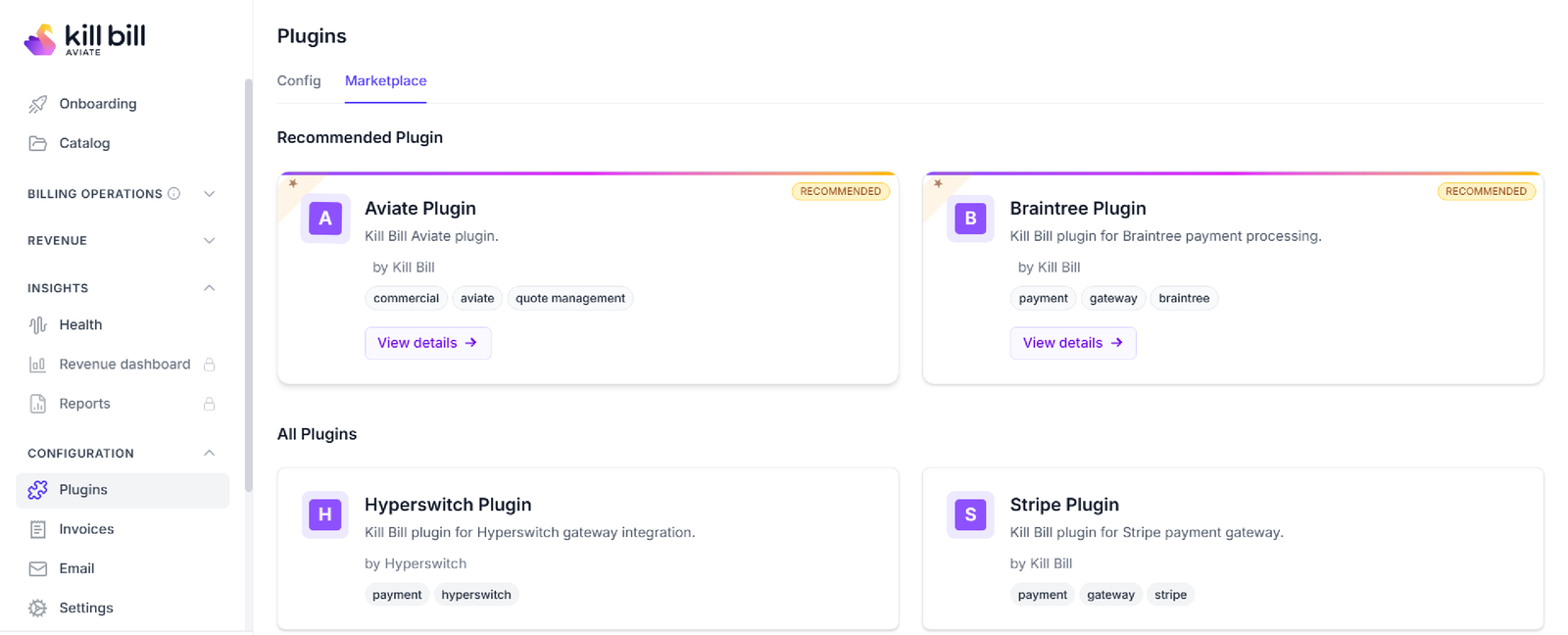
Aviate, the web interface for one or more Kill Bill deployments.
Trusted by companies processing billions in revenue









Open source since 2010Apache 2.0 license

Your infrastructureYour database, your data

Scale outStateless nodes behind a load balancer

Aviate supportLevel 3, engineers on a dedicated Slack
Open Source and Enterprise
What Kill Bill Does, What Aviate Adds
Kill Bill is the open-source billing engine. Aviate is the commercial offering built on it: it adds tools and support on top of Kill Bill and replaces nothing.
Open source
Apache 2.0. Free and self-hosted. No support or SLA.
- Subscription and usage billing, catalog and invoicing
- Stateless clusters behind a load balancer
- Multi-tenancy on one deployment
- Dunning and payment retries
- Payment and tax plugins
- Kaui admin UI and REST APIs
- Usage billing per subscription: consumable or capacity
 Aviate
Enterprise
Aviate
Enterprise
The commercial offering built on Kill Bill.
- Aviate: one web interface for one or more deployments
- Aviate Health: metrics, stuck events, diagnostic reports
- Aviate Metering: send raw usage events, Aviate aggregates them
- Aviate Wallet: prepaid credit drawn down by usage
- Catalog and pricing managed from the UI
- Level 3 support: engineers on a dedicated Slack, first response within one business day for a P1
Capabilities
What You Can Do
Run billing infrastructure that scales with your business and gives ops teams full visibility.
 Kubernetes
 Docker
 AWS Marketplace (Premium)
 Tomcat (WAR)
Databases
Tomcat (WAR)
Databases MySQL
MySQL MariaDB
 PostgreSQL
 Open source
Horizontal Scaling
Kill Bill is stateless. Add more application nodes behind a load balancer to handle increased volume. The load balancer spreads requests across nodes.
Kubernetes deployment →
 Open source
Multi-Tenancy
Run multiple businesses, brands, or divisions on a single Kill Bill deployment. Each tenant gets its own catalog, plugin settings and data. Manage everything through tenant-aware APIs.
Multi-tenancy guide →
 Open source
High Availability
Run at least two stateless nodes behind a load balancer, with a primary and a replica database. If the database fails over, Kill Bill reconnects automatically.
Deployment guide →
 Aviate
Aviate Health Monitoring
Aviate Health provides per-minute metrics, stuck-event detection, and diagnostic tools. Monitor queues, database connection pools and processing latency, resolve stuck events, and generate diagnostic reports. Aviate Health is part of Aviate.
Health monitoring →
 Open source
Flexible Deployment
Deploy with Docker, Docker Compose, Kubernetes or Tomcat, in your cloud account or data center. Premium AWS Marketplace images are also available.
Deployment options →
 Open source
Dunning and Entitlement
Automated retry logic for failed payments with configurable dunning policies. When payments fail, Kill Bill manages the retry schedule and entitlement state according to your rules, and sends overdue events you can use to notify customers.
Dunning policies →
Usage-Based Billing
Consumption Billing at Enterprise Scale
Kill Bill records usage per subscription through its usage API. Aviate Metering adds raw event ingestion.
 Open source
Kill Bill Open Source
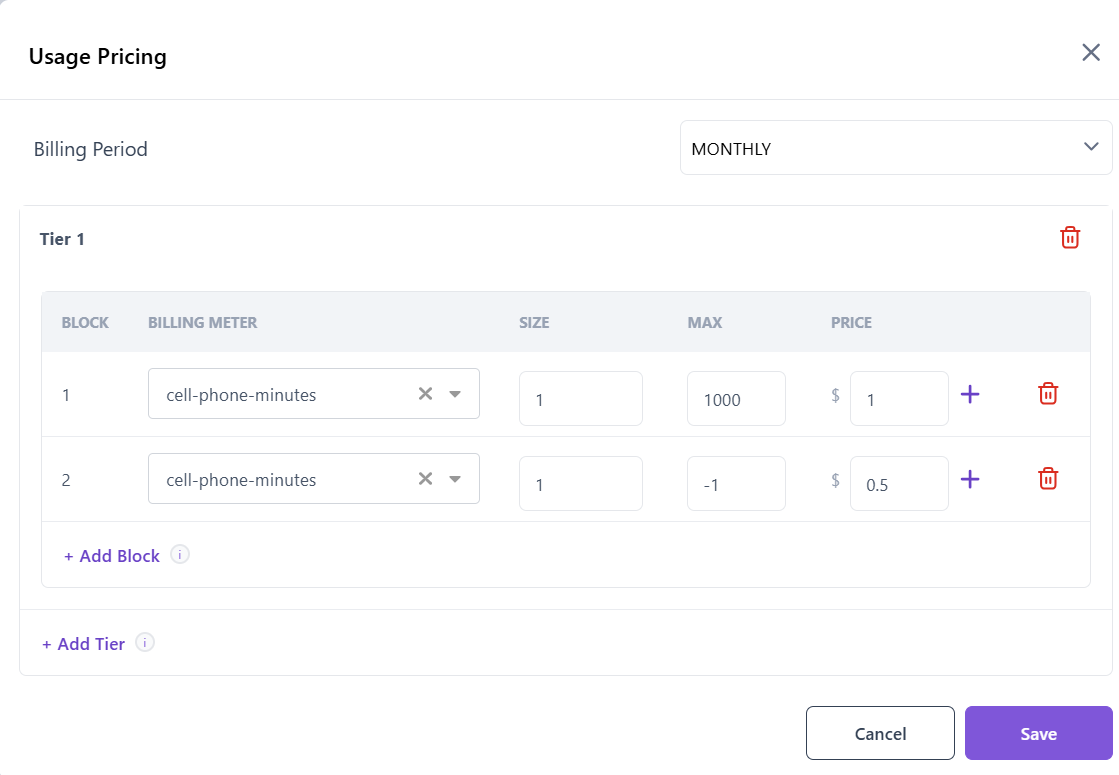
Records usage per subscription and rates it at invoice time against the catalog: tiers, volume pricing or per-unit rates. Consumable usage is summed per period, capacity usage is priced by its peak. Roll up very high event volumes first.
 Aviate
Aviate Metering
Ingests raw usage events and aggregates them per billing period with billing meters, so you do not build the aggregation layer yourself. Use either the open source usage API or Aviate Metering, not both.
 Open sourceWallet: Aviate
Billing Models
Usage is invoiced in arrears and can sit next to recurring fees on the same invoice. Prepaid credit drawn down by usage uses the Aviate Wallet.
Usage metering →
How It Works
From Deployment to Production Operations
1
Deploy on Your Infrastructure
Choose your deployment target: Kubernetes, Docker Compose or Tomcat. Configure your database, connect plugins, and set up tenants. Kill Bill includes deployment guides for each environment.
2
Configure Operations
Set up tenants, payment retries and dunning policies. If you run Aviate, enable Aviate Health. Add nodes as load grows.
3
Monitor and Scale
Aviate Health shows per-minute metrics for every node and finds stuck events. Add nodes as load grows.
Why Kill Bill
Why Teams Choose Kill Bill for Enterprise Operations

No Vendor Lock-In
Self-host on your own infrastructure. Migrate between cloud providers freely. Your billing data, configuration, and customizations are always under your control.

Proven at Scale
Deployments on the platform have invoiced billions of dollars since 2010. Thousands of tests run before each release.

Operational Visibility
Aviate Health provides metrics, diagnostics, and stuck-event detection. See queue, pool and request metrics for every node.
Fault Tolerance
Payment calls are idempotent. Payment retries are configurable. Events are stored in the database and are not lost when a node fails. After a database failover, Kill Bill reconnects automatically.

Multi-Business Support
Multi-tenancy lets you serve multiple brands, business units, or customer segments from one deployment. Reduce infrastructure and operational overhead.

Total Cost Advantage
Open source core with optional enterprise accelerators. No per-transaction fees that scale with your success. Invest in your billing infrastructure instead of paying rent on someone else's.
FAQs
Frequently Asked Questions
How many transactions can Kill Bill handle?
Kill Bill nodes are stateless. You add nodes behind a load balancer as load grows. All nodes share one database, so size the database for your volume. Deployments on the platform have invoiced billions of dollars since 2010.
Can I run Kill Bill on Kubernetes?
Yes. Kill Bill is containerized and its nodes are stateless, so you can run several replicas. When nodes come and go, use the default POLLING bus mode. The Kubernetes guide in the docs covers a single-replica starter setup.
What does multi-tenancy mean in Kill Bill?
Each tenant in Kill Bill has its own catalog, plugin settings, configuration, and data. Tenants share the same application and database infrastructure but are logically isolated. This lets you run multiple brands, divisions, or customers on a single deployment.
How does Aviate Health help operations?
Aviate Health monitors the billing engine with per-minute metrics. It tracks processing latency, detects stuck events that need intervention, and provides diagnostic tools for troubleshooting. Metrics are exposed through dedicated API endpoints.
What databases does Kill Bill support?
Kill Bill supports MySQL, MariaDB and PostgreSQL in production. Schema upgrades are applied with migration scripts, for example with KPM and the Flyway command-line tool.
Do I need to pre-aggregate usage events?
Not always. The Kill Bill usage API takes usage records per subscription. Consumable usage is summed per period. Capacity usage is priced by the tier its peak reaches. For very high event volumes, roll records up first, or use Aviate Metering, which takes raw events and aggregates them. Use one or the other, not both. Either way, the result is a USAGE line on the invoice.
What is in Kill Bill open source, and what does Aviate add?
Clustering, multi-tenancy, dunning, Docker, Kubernetes and Tomcat deployment, and per-subscription usage billing are part of Kill Bill open source, free and without support or SLA. Aviate adds Aviate Health, Aviate Metering for raw usage events, and Level 3 support with a first response within one business day for a P1.
Last reviewed: October 2026
Ready to Run Billing at Scale?
Explore Kill Bill's enterprise deployment options, multi-tenancy, and operational tooling. Start with the sandbox or talk to our team about production architecture.